




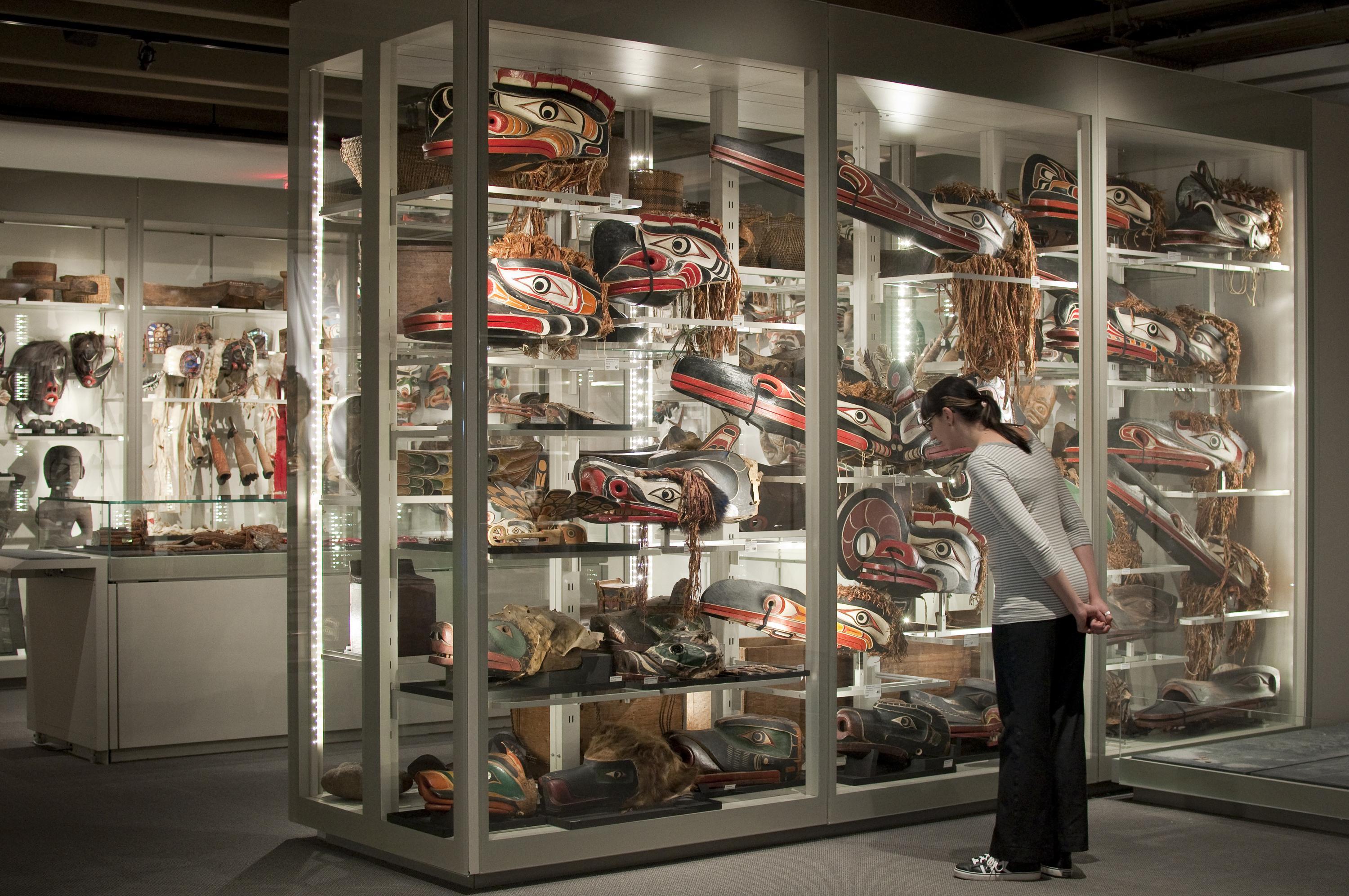

Hello MOA blog readers! I’m Michelle and I’ve just completed a collections practicum at MOA. Over the summer I have had the opportunity to work on a variety of fun projects, from cataloguing new acquisitions, to preparing objects for freezing and anoxia, to oddy testing new materials and making storage mounts for fragile textiles.
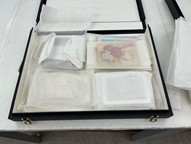
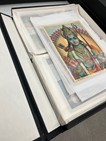
One of my main projects was to rehouse and reorganize MOA’s works on paper. MOA’s works on paper collection consists of over 6000 objects, spanning paintings, posters, prints, ephemera, and more. I was tasked with solidifying a standard set of procedures for rehousing and reorganization to improve storage and aid retrievability.
Previously, items were wrapped in tissue individually or in bundles without visible labels on the exterior and stacked in boxes and drawers. As such, finding a specific item could be difficult and time-consuming. It also created a higher risk of unintended damage, as items had to be unwrapped and handled more frequently.


With key objectives of safety and accessibility in mind, works were reorganized and rehoused labelled clearly with a tab style system for quick identification and retrieval.
Depending on the size, weight, and condition of the object, different storage methods were employed, such as mylar folders, encapsulation, and matboard enclosures.Most objects have been rehoused into mylar folders. Mylar is a polyester film that is inert and acid-free, making it a good material to use for storage. The clear plastic also allows us to see what is inside without needing to take the object out.
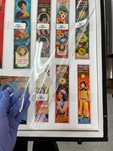


Some objects are more fragile and not suitable for folders. To provide a bit more stability and support, these objects are placed between two sheets of mylar and sealed with encapsulation tape.
Other enclosures include customized boxes and matboard folders with mylar covers. Boxes are useful for thicker items that cannot fit into a folder, and can also be used to keep a certain group of materials together. For small, thin items, we created matboard folders with mylar covers that allow for objects to be viewed and handled without direct contact.


By implementing these storage methods, objects can be more easily identified and retrieved, while minimizing direct handling. So far, 1500 works have been rehoused.
Michelle Wong is a student at the University of Toronto, studying a dual degree of Master of Museum Studies (MMSt) and Master of Information (MI). From July to August 2026, as part of her degree requirements, she completed her collections practicum with the Collections Care, Management and Access Department at MOA.